
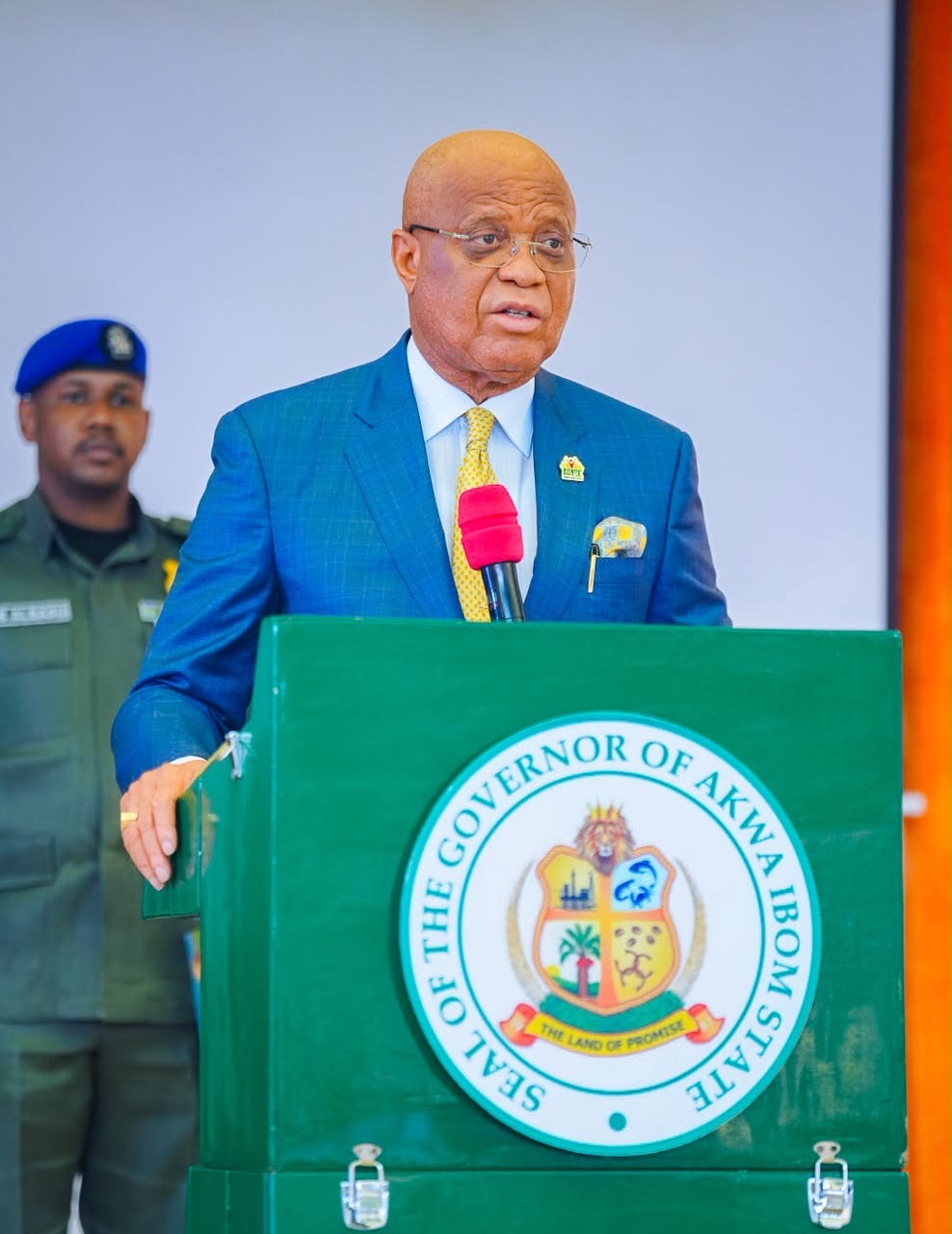
By Ekemini James
It was Abraham Lincoln who once said, “The best way to predict your future is to create it.” It was a simple statement, yet profound in its implication that leadership is ultimately measured not by promises made, but by the courage, vision and discipline deployed in shaping outcomes.
Three years ago, Pastor Umo Eno stood before Akwa Ibom people and unveiled a development blueprint known as the ARISE Agenda.
Three years down the line, the narrative has changed due to the Governor’s deliberate choices, strategic investments and a determined effort to transform aspiration into reality through the instrumentality of the ARISE Agenda.
Already, it has become a defining tradition of the current administration to commence each political year with prayers and thanksgiving to God. This is why he began the fourth year of his administration with a three-day Prayer Summit themed “God of Awesome Wonders.”
For Governor Eno, governance has been framed as service, compassion and development. Three years later, the footprints of the ARISE Agenda can be seen across every sector and every local government area of the state.
The story begins in the rural communities.
Today, roads now connect previously isolated communities to markets and economic opportunities. Markets have emerged as centres of commercial activity.
Solar-powered water projects are bringing relief to communities long burdened by water scarcity. Model healthcare centres and model primary schools are changing the face of public infrastructure in the hinterlands.
Recently, over N7.3 billion has been approved for the establishment of women cooperatives across the 369 wards in the state, working in partnership with GIFA.
Plans are underway to provide solar-powered borehole facilities in every ward, ensuring that development reaches the people where they live.
At a time when food security has become one of the greatest challenges facing the nation, Akwa Ibom has responded with deliberate investments in agricultural production and value-chain development.
The launch of the Oil Palm Revolution Programme signals a determined effort to reclaim the state’s historic place as a leading oil palm producer.
Through the Ibom Model Farm initiative, ARISE Home Farms Scheme, Back-to-Farm Programme and Agricultural Equipment Leasing Company, the Governor is encouraging increased participation in farming while making mechanized agriculture accessible to ordinary farmers.
More than 750,000 cocoa seedlings, over 700,000 oil palm seedlings and thousands of bundles of cassava cuttings have been distributed to farmers across the state. Rice farmers have received improved seedlings, agrochemicals and farm equipment. Grants worth billions of naira have been extended to farmers to stimulate production.
Beyond agriculture, infrastructure remains one of the strongest signatures of the administration.
Over 1,300 kilometres of economically viable roads and more than 40 bridges have either been completed or are under construction. Strategic projects such as the Ikot Akpaden-Iko Road, Okopedi-Oron Road dualization, airport corridor expansion, internal road networks and numerous rural access roads are redefining connectivity across the state.
The aviation sector has witnessed what may arguably be one of the most ambitious transformations in the state’s history.
The completion of the new international terminal at Victor Attah International Airport has ushered Akwa Ibom into a new era of connectivity. The state’s maiden international flight to Accra, Ghana, also marked a significant milestone in that journey.
Ibom Air, the state owned airline, continues to expand its fleet with newly acquired aircraft. The construction of Aviation Village, airport hospital, Maintenance Repair and Overhaul facility, taxiway expansion, perimeter fencing and supporting infrastructure is gradually transforming the airport environment into a comprehensive aviation ecosystem.
In education, the administration has pursued a vision anchored on access, quality and competitiveness.
Free and compulsory education continues to receive government support. Student bursaries have been increased to N50,000.
The transformation of the College of Education into the Akwa Ibom State University of Education represents a significant milestone in tertiary education development.
Across local government areas, model primary schools equipped with solar power, computer laboratories and teachers’ quarters are redefining the learning environment. The recruitment of 1,000 teachers and approval for another 1,000 teachers demonstrates the government’s commitment to improving learning outcomes.
Healthcare tells an equally compelling story.
The ongoing construction of the 350-bed Ibom International Hospital represents one of the administration’s most ambitious healthcare projects. Across the state, healthcare facilities are being renovated and upgraded.
The establishment of AKISEMSAS has improved emergency response services. Dialysis centres have been installed in key hospitals. Oxygen plants have been expanded. More importantly, over 2,854 healthcare professionals have been recruited to strengthen service delivery.
Through the Akwa Ibom State Health Insurance Agency, more than 200,000 residents now enjoy access to affordable healthcare services.
In the area of security, the establishment of the Ministry of Internal Security and Waterways, operationalization of the Security Trust Fund, deployment of the Ibom Community Watch and creation of a modern Command and Control Centre have significantly strengthened the state’s security architecture.
The current administration has also facilitated the establishment of additional military and security formations, including a Counter-Terrorism Unit Base, Naval facilities, Air Force presence and enhanced policing infrastructure.
Perhaps nowhere is the compassionate side of governance more visible than in the administration’s social intervention programmes.
On assumption of office, Governor Eno inherited gratuity obligations running into about N111 billion and today over N83 billion has been paid, bringing relief to retired civil servants who had waited years for their entitlements.
Also, thousands of traders, farmers, artisans and entrepreneurs have benefitted from empowerment grants exceeding six billion naira.
Through the Elderly Citizens Support Scheme, senior citizens have received direct financial assistance. The ARISE Compassionate Homes Programme has provided decent housing for widows, vulnerable families and indigent citizens.
Over 650,000 households have benefitted from food intervention programmes designed to cushion economic hardship.
The youth have not been left behind. Through IBOM-LED, DASAC and other empowerment initiatives, thousands of young people have acquired entrepreneurial and vocational skills.
The newly launched Youth Development Centre in Oron represents another strategic investment in the future generation. Designed to provide training in e-commerce, digital innovation, fashion and creative industries, the initiative seeks to position Akwa Ibom youths for emerging global opportunities.
In housing, Governor Eno has delivered more than 1,048 housing units through various projects, including Compassionate Homes, Aviation Village, Medical Village, Judiciary Village, Legislative Village and the ARISE Estate.
Tourism development remains central to the administration’s diversification strategy.
From the ARISE Palm Resort to the International Conference Centre, the Amphitheatre, Ibom Hotels, Unity Park, Ibom Plaza and the emerging ARISE Shopping City, the administration is laying the foundation for a tourism economy capable of generating jobs, attracting visitors and stimulating investment.
The Ibom Deep Seaport project, Ibom Industrial City, electricity sector reforms, power infrastructure expansion, sports academy development, modern transportation projects including the new bus terminal and the deployment of CNG buses all point to an administration thinking beyond immediate needs.
As Governor Umo Eno begins the fourth year of his administration, the conversation is gradually shifting from implementation to legacy.
The Governor has called the next phase ARISE 2.0 — a vision designed to build on existing foundations and execute more ambitious projects capable of transforming Akwa Ibom into one of Nigeria’s leading economic destinations.
But perhaps the most significant achievement of the last three years is not found in budgets, statistics or project signboards.
It is found in the restoration of confidence.
The confidence of a farmer who sees agriculture as a business.
The confidence of a student who dreams beyond the classroom.
The confidence of a pensioner whose gratuity is finally paid.
The confidence of a widow who receives a home.
The confidence of an investor who sees opportunities in a peaceful and stable environment.
Three years ago, the promise was to ARISE.
Today, the evidence is visible across the state.
Yet, beyond the projects and investments, perhaps the greater legacy being nurtured is a culture of peace, unity and a common vision for progress.
At the recently concluded Prayer Summit, Governor Umo Eno reminded political actors that elections should be contests of ideas, not insults, while calling on religious leaders and citizens alike to embrace unity for the continued progress of the State.