
The Ekid nation has raised a resounding alarm over what it describes as a deliberate, sustained and criminal distortion of history, law and territorial boundaries, warning that continued silence by the Akwa Ibom State Government amounts to endorsing injustice and sowing the seeds of future unrest.
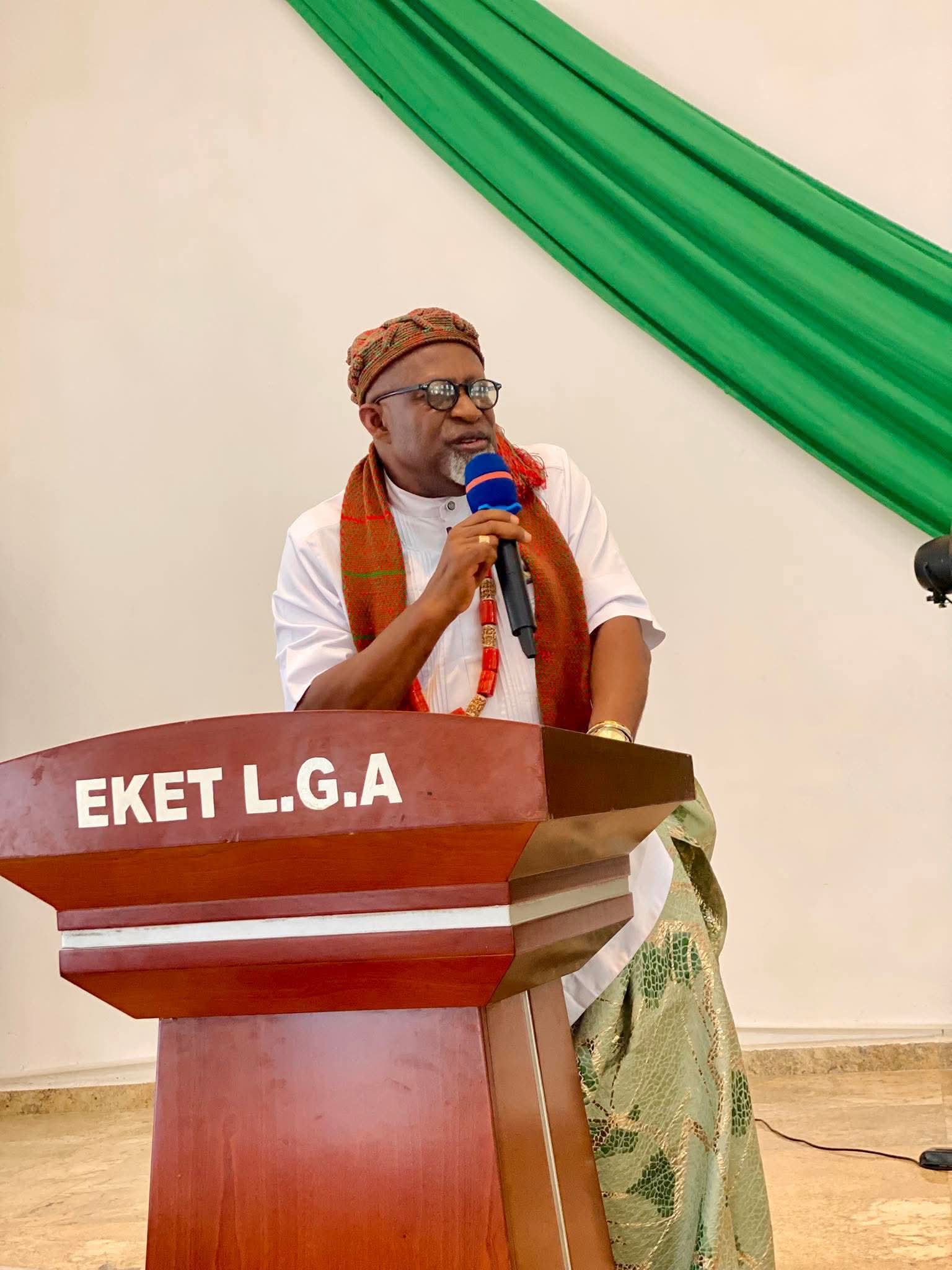
This was made public in a speech delivered by Dr Samuel Udonsak, President General of EPU, during the 2025 Annual National Congress of the Union on Friday 19th December 2025.
At the heart of the agitation is the wrongful administrative transfer of Ekid villages to Ibeno Local Government Area, a development Ekid leaders insist has no legal, historical or judicial foundation. They argue that from the era of Eastern Nigeria Edicts through Cross River State Law No. 9 of 1983, Ekid villages were consistently and correctly listed under their rightful jurisdictions. Even after the creation of Akwa Ibom State, Edict No. 15 of 1990 maintained this correct listing under the defunct Uquo-Ibeno Local Government Area.
However, Ekid stakeholders insist that the injustice began with the Traditional Rulers Council (TRC) Law of 2000, which, following the creation of Ibeno LGA, deliberately and wrongly listed all Uquo villages as villages of Ibeno LGA. This distortion, they say, was not only provocative but fundamentally unlawful.
Persistent protests and agitations forced government intervention, leading to the Traditional Rulers (List of Recognised Villages and Clans) Revocation Order of 2008, which expressly revoked the faulty listing. Yet, 17 years after that revocation, the state has failed to enact a new enabling law to correctly relist the villages. As a result, Ekid villages in Esit Eket Local Government Area continue to be illegally administered as villages of Ibeno LGA, under a law that no longer exists.
“To all intents and purposes,” Ekid leaders argue, “Akwa Ibom State has been running villages and clans under an edict that was formally revoked.” They lament that instead of enforcing the law, Ekid people have been reduced to pleading endlessly, like an emasculated people, for what is already theirs by right.
Beyond administrative injustice, Ekid elders warn of a far more dangerous trend: the systematic confiscation of the Stubbs Creek Forest Reserve (Akoiyak). They remind the state that the Stubbs Creek Forest Reserve Ordinance of 1930 was never an acquisition, but merely a regulatory framework. This position, they stress, aligns perfectly with the 1918 Privy Council Judgment, which unequivocally vested ownership of the lands and swamps from the mouth of the Qua Iboe River to Child Point (Okposo) in the Ekid people.
That judgment, they insist, permanently excludes Ibeno or its proxies from any claim, opinion or negotiation over Akoiyak.
Yet, despite this settled legal position, successive governments have allegedly misinterpreted the ordinance to justify what Ekid leaders describe as an embarrassing and criminal confiscation of their ancestral inheritance. Today, companies such as BUA and TULCAN are said to be occupying portions of the forest illegally, while proposed projects involving the Nigerian Navy, Oriental Energy and Emade Energy threaten to further erode Ekid land.
“What will be left of the 310 square kilometres of the Stubbs Creek Forest?” Ekid leaders ask pointedly. “What inheritance are we passing on to our children?”
They further cite the Akwa Ibom State Map Establishment Law of 2023, which remains valid and subsisting, noting that the official state map, certified by the Surveyor-General and submitted to the National Boundary Commission, clearly defines local government boundaries. The same map, now publicly accessible including on Google, contradicts the ongoing expansion of Ibeno into Ekid territories.
Despite this, Ekid leaders accuse Ibeno LGA of openly defying the law by building and occupying land outside its boundaries, while companies like Seplat Energy allegedly rename the QIT Terminal in Eket as “QIT Terminal Ibeno,” in what Ekid stakeholders describe as a criminal misrepresentation. Even more troubling, they say, is that government institutions continue to administer Ekid territories as though they belong to Ibeno, in direct violation of existing laws.
The strongest rebuke, however, is reserved for Ekid’s own political class and leadership. The speech condemns what it calls the complacency, cowardice and dangerous calmness of present-day Ekid youths, elites and politicians in the face of “extreme provocations.”
“This silence,” the leaders warn, “is extinguishing the glorious flames of resistance and resilience that defined the Ekid of our forebears.”
The Ekid nation now demands immediate corrective action, including the proper legal relisting of its villages and strict enforcement of boundary and land laws. They insist this is not merely a political request, but a necessary step to restore justice, protect heritage, and preserve peace in Akwa Ibom State.