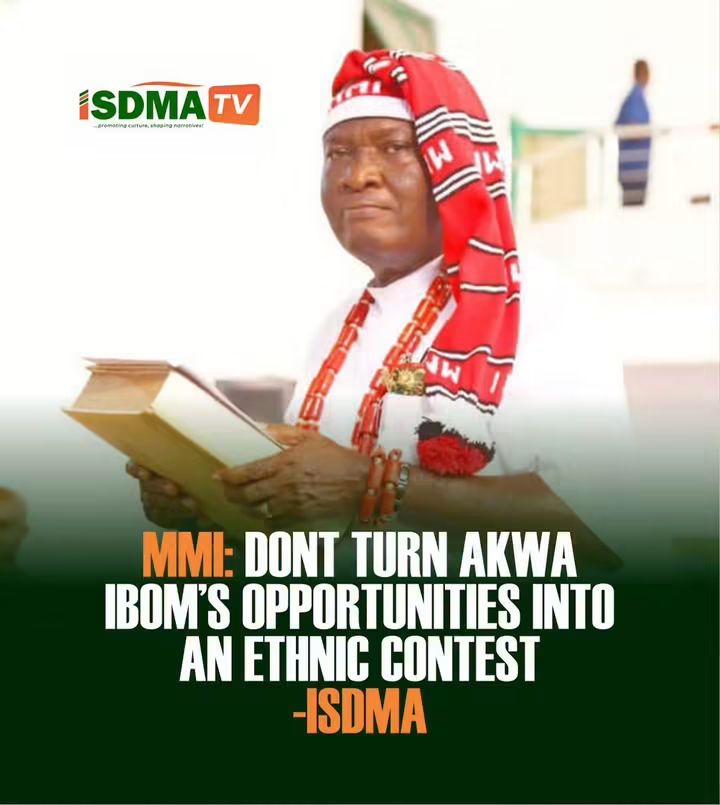
… MMI, DON’T TURN AKWA IBOM’S OPPORTUNITIES INTO AN ETHNIC CONTEST
The attention of the Ikot Ekpene Senatorial District Media Advocates (ISDMA) has been drawn to a recent press statement by Mboho Mkparawa Ibibio (MMI), alleging that the Honourable Minister of State for Petroleum Resources (Oil and Gas), Obongemem Ekperikpe Ekpo, has distributed employment opportunities disproportionately in favour of his senatorial district.
We consider the allegation deserving of a response, not because public officials should be shielded from scrutiny, but because the manner in which this particular issue has been presented risks transforming a legitimate conversation about access to public opportunities into an ethnic contest.
THE SOURCE OF THE ALLEGED LIST MUST FIRST BE ESTABLISHED
First, the purported list upon which MMI appears to have based its allegation did not emanate from any official media platform or verified communication channel of the Honourable Minister.
It is therefore premature and unfair to draw sweeping conclusions about ethnic discrimination from a document whose source, authenticity and circumstances of compilation have not been publicly established.
Public criticism must be anchored on verifiable facts. If MMI has concerns about the distribution of federal opportunities, the appropriate approach is to seek clarification from the relevant authorities and establish the facts, rather than proceed from an unverified document to an allegation of ethnic bias.
But even assuming, without conceding, that the list is genuine, we ask MMI a simple but fundamental question: Are the beneficiaries not Akwa Ibom people? And more importantly, should every opportunity facilitated for an Annang person automatically be interpreted as an opportunity taken away from an Ibibio person?
IKOT EKPENE SENATORIAL DISTRICT IS AKWA IBOM
MMI should also remember that Ikot Ekpene Senatorial District is not exclusively Annang territory. The district comprises ten (10) Local Government Areas, including two predominantly Ibibio LGAs, Ikono and Ini. For decades, the people of Ikono and Ini have lived, worked and participated fully in the political, economic and social life of the district. They are not minorities in citizenship, entitlement or dignity.
They contest elections, occupy political offices, serve in public institutions, conduct businesses and contribute to the development of the district alongside their brothers and sisters from the Annang-speaking areas.
If we can coexist as one Senatorial District and proudly identify as constituents of the same political constituency, why should an employment opportunity suddenly become an ethnic issue?
WHAT HAS THE MINISTER DONE BEYOND HIS SENATORIAL DISTRICT?
The attempt to portray the Minister’s interventions through an ethnic lens also overlooks several initiatives that have benefited, or are positioned to benefit, communities and interests outside his immediate senatorial district.
The Minister has supported efforts towards securing up to ₦20 billion in financing under the Midstream and Downstream Gas Infrastructure Fund (MDGIF) for Nsik Oil and Gas, an Ibibio-owned enterprise. The proposed investment has the potential to expand gas utilisation, stimulate infrastructure development and create employment opportunities for Ibibio people and other Akwa Ibom citizens.
He has also championed the expansion of Compressed Natural Gas (CNG) infrastructure across the state, including CNG daughter and conversion stations in Ikot Abasi and the facility established at the University of Uyo.
The Minister further supported the groundbreaking of Guelph Gas Limited’s CNG Mother Station in Ibesikpo Asutan Local Government Area, with a stated capacity of three million standard cubic feet of gas per day and plans to supply commercial and industrial customers across the South-South and South-East. For emphasis, Ibesikpo Asutan is not Annang land.
Beyond these interventions, the Minister’s support has also been associated with efforts to attract a reported $3.5 billion gas infrastructure and industrialisation deal involving the Akwa Ibom State Government, NNPC Limited and the Gas Aggregator Company Nigeria, with the broader objective of positioning the South-South as a major value-addition and industrial hub. These are not ethnic but Akwa Ibom investments.
The Minister’s interventions have also extended beyond oil and gas. In education and digital development, modern ICT centres have been attracted to locations including Etinan, Oron, Uyo, Eket, Itu, Ikot Abasi, Esit Eket and Ikono, with more expected.
If the question is whether the Minister’s office is creating opportunities beyond his immediate senatorial district, then the evidence does not support an ethnic narrative. We therefore demand MMI to apply the same standard of fairness consistently.
We dare to ask: when cooking gas cylinders were distributed across the state just recently, were they distributed exclusively to Annangs? When federal appointments, employment opportunities and other interventions are facilitated for sons and daughters of Ibibio extraction, do Annangs demand that such opportunities be redistributed simply because the beneficiaries are Ibibio?We believe the answer is obvious.
An opportunity reaching an Annang is an Akwa Ibom opportunity. An opportunity reaching an Ibibio is equally an Akwa Ibom opportunity. The Honourable Minister occupies a federal office. While he naturally remains accountable to his constituents, his responsibilities and the opportunities facilitated through his office cannot be reduced to the boundaries of one senatorial district.
Every Akwa Ibom indigene has a legitimate stake in federal opportunities. That is why we must resist the dangerous practice of turning employment, appointments, contracts, projects or government interventions into an ethnic scoreboard.
POLITICAL DISAGREEMENTS MUST NOT BECOME ETHNIC BATTLES
We must equally be careful not to allow disagreements involving public officials to acquire ethnic dimensions.
Recent attempts by some individuals, including an Ibibio son known as Sport Sailor, to question the competence and activities of the Chairman of the National Assembly Service Commission, Dr. Saviour Enyiekere, an Annang son, demonstrate how quickly legitimate political or administrative disagreements can be given an ethnic interpretation.
For the avoidance of doubt, public officials can and should be questioned. Government can and should be held accountable. Institutions can and should be scrutinised. But none of these should become an excuse for ethnic mobilisation.
The moment every disagreement involving an Ibibio and an Annang is presented as an Ibibio-versus-Annang struggle, we cease to interrogate issues on their merits and begin to weaken the very unity that has held Akwa Ibom together.
A 39-YEAR LEGACY OF UNITY MUST NOT BE ACRIFICED
We remind the Akpawara Ini-Abasi Ekanem-led MMI Executive Council, barely two months into its tenure, that Mboho Mkparawa Ibibio, since its establishment in 1987, has built a 39-year history of engagement, advocacy and cordial relations with other ethnic groups across Akwa Ibom. That legacy is bigger than any individual, political disagreement or temporary controversy.
We therefore urge the new leadership of MMI not to permit the politics of the moment to erode the bridges built by generations before it.
The people of Akwa Ibom have far more in common than what divides us. Our shared identity, common interests and collective aspirations must remain stronger than political disagreements and ethnic sentiments.
Governor Umo Eno’s philosophy of “Akwa Ibom United,” reinforced by his collaboration with Senate President Godswill Akpabio and other leaders of the state, should not merely be a government slogan. It should be a collective responsibility.
Our message is simple: Let us demand fairness without manufacturing division. Let us seek accountability without weaponising ethnicity. Let us question government without questioning our shared identity as Akwa Ibom people.
The future of our young people should not be reduced to an ethnic arithmetic of who got more jobs or who got fewer appointments. What we should be demanding is an expanded opportunity space in which more Akwa Ibom people; Annang, Ibibio, Oro, Eket, Ibeno, Obolo and all other ethnic groups can benefit.
Akwa Ibom belongs to all of us and our opportunities must unite us, not divide us.