
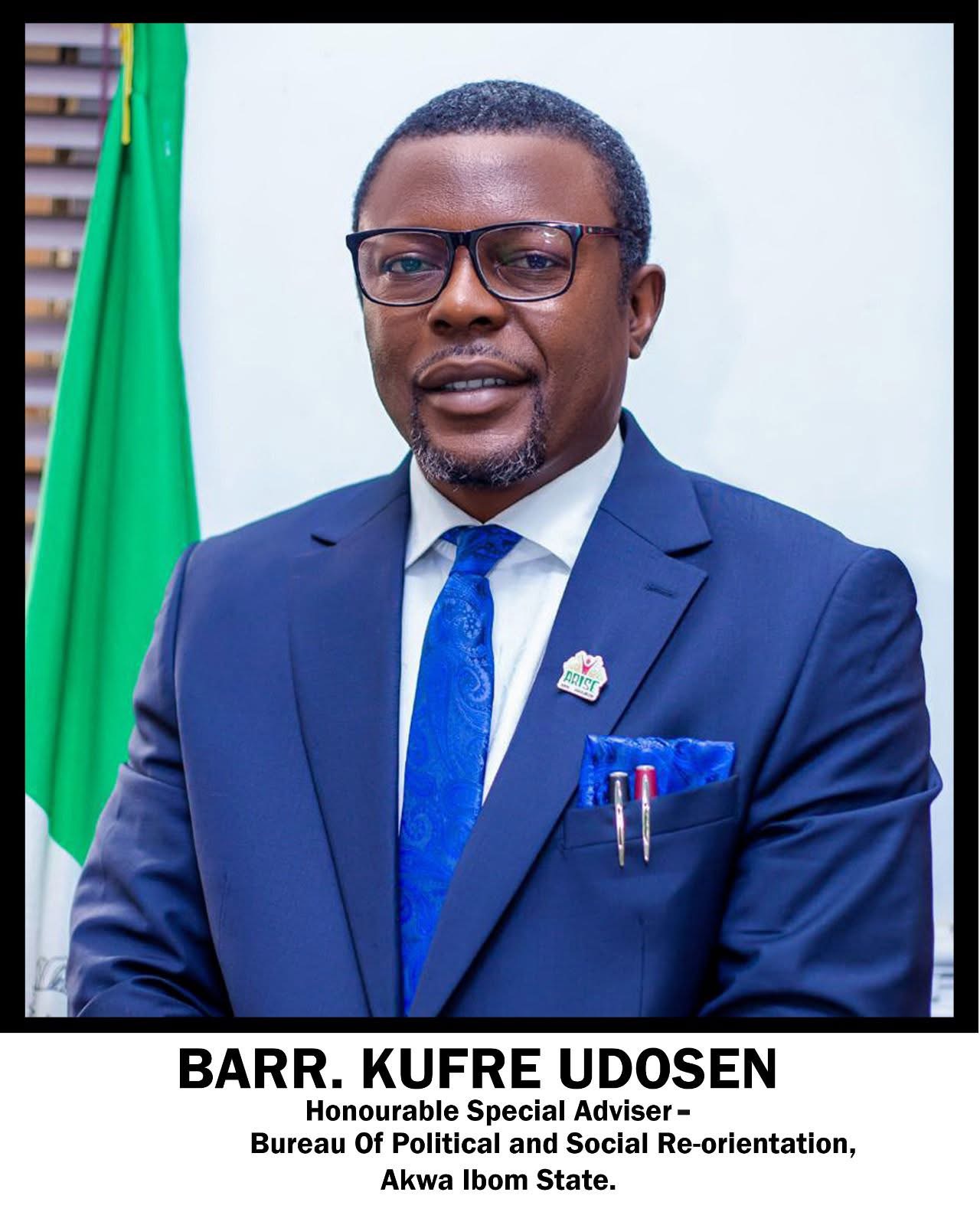
— Barr. Kufre Udosen
Says Constructive Criticism Must Recognize Achievements, Not Merely Search for Faults
Barr. Kufre Udosen, Honourable Special Adviser to the Governor on Political and Social Re-orientation, has called for a more responsible and intellectually honest approach to public criticism, cautioning against the growing trend of condemning government actions without acknowledging measurable achievements.
Speaking against the backdrop of increasing politically motivated attacks on the administration of Governor Umo Eno, Udosen stated that while criticism remains a legitimate and indispensable component of democracy, it loses credibility when it becomes detached from facts, fairness, and objectivity.
According to him, the purpose of criticism should be to improve governance through constructive engagement rather than to satisfy political interests, personal grievances, or partisan sentiments.
“Every democratic government should welcome scrutiny. However, criticism must not descend into the dissemination of falsehoods, distortion of facts, or deliberate refusal to acknowledge visible progress. Democracy flourishes through informed debate, not through unsubstantiated attacks,” he stated.
Udosen noted that Governor Umo Eno’s administration has continued to implement people-oriented programmes and projects across critical sectors, including rural development, agriculture, healthcare, education, infrastructure, entrepreneurship, tourism, and human capital development.
He argued that intellectual honesty demands that public commentators evaluate government performance in its entirety rather than selectively highlighting perceived shortcomings while ignoring significant accomplishments.
“A critic who only sees faults and never achievements is much like a man who stares at the sun yet insists there is no sunlight. Such a person is not engaged in objective analysis but in a deliberate rejection of reality,” Udosen remarked.
The Special Adviser further observed that many citizens often misunderstand the fundamental role of government in modern societies.
According to him, no government anywhere in the world can directly place food on the table of every citizen. Rather, the primary responsibility of government is to create and sustain an enabling environment where businesses can thrive, investments can flourish, jobs can be created, and citizens can pursue economic opportunities in conditions of peace, security, and stability.
“Government is not designed to become the personal provider for every individual. Its duty is to establish the conditions that allow citizens to succeed through their own enterprise and hard work. Across the world, successful governments are judged by how effectively they create opportunities, stimulate economic activities, and maintain an environment conducive for growth and prosperity,” he explained.
Udosen maintained that Governor Umo Eno has demonstrated commitment to these responsibilities by prioritizing security, social harmony, infrastructural development, economic empowerment, and policies aimed at expanding opportunities for the people of Akwa Ibom State.
He particularly lamented what he described as the unwillingness of many critics to acknowledge the remarkable level of peace and security currently being enjoyed across the state.
“It is unfortunate that while some individuals are quick to criticize government at every opportunity, I have hardly seen any of these critics publicly commend the Governor for the deliberate efforts he has made in sustaining peace and security across Akwa Ibom State. Security is the foundation upon which every other form of development rests. Investors do not invest where there is insecurity, businesses do not thrive where there is instability, and communities cannot prosper where there is conflict,” he said.
According to him, the prevailing atmosphere of peace in the state is not accidental but the result of deliberate policies, strategic engagements, and sustained commitment by the administration to ensure the safety of lives and property.
The Special Adviser further observed that history has consistently shown that great societies are built through collaboration between leaders and citizens, where criticism is accompanied by ideas, alternatives, and solutions.
According to him, it is not enough to merely identify challenges; responsible public engagement requires proposing practical pathways for improvement.
“Anyone can criticize. Leadership, however, demands the courage to offer solutions. If individuals believe government should have acted differently, they should equally be prepared to explain what alternative course of action they would have pursued and why it would have produced better outcomes,” he said.
Udosen also drew from biblical and philosophical principles, emphasizing that respect for constituted authority does not preclude criticism but rather requires that such criticism be exercised with civility, truthfulness, and a sincere commitment to the common good.
He maintained that the administration of Governor Umo Eno remains open to constructive feedback and policy suggestions but would continue to reject narratives built on misinformation, personal attacks, and political mischief.
“The strength of an argument lies in facts, evidence, and reason—not insults, exaggerations, or character assassination. Public discourse should elevate society, not degrade it,” he added.
Concluding, Udosen urged citizens, political actors, and public commentators to place the collective interest of Akwa Ibom State above partisan considerations.
“Let us disagree where necessary, but let us do so with integrity. Let criticism be factual, balanced, and solution-driven. Let us acknowledge achievements where they exist and challenge shortcomings where they arise. That is the pathway to progress, maturity, and sustainable development.”
He stressed that history ultimately rewards those who contribute to nation-building and not those who merely seek fault in every effort made to advance the welfare of the people.