
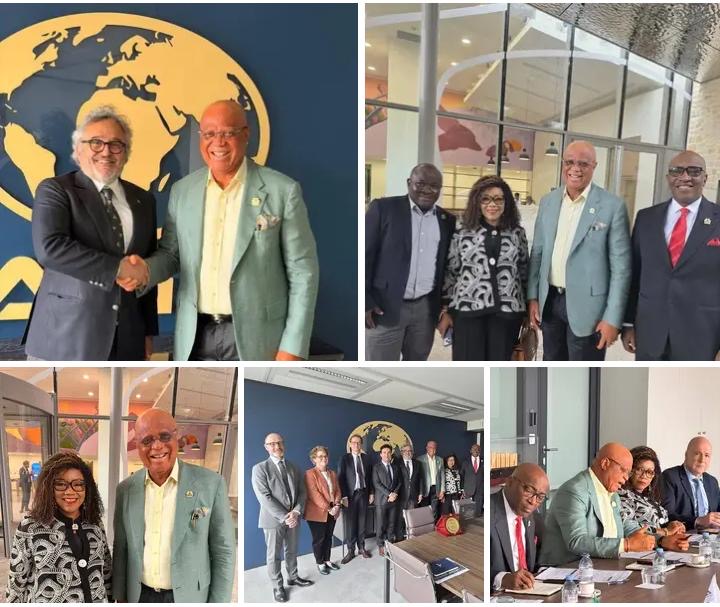
Governor Umo Eno’s recent meeting in Paris, France, with Africa Global Logistics (AGL) Group and other partners on the Ibom Deep Sea Port Project has once again demonstrated the administration’s determination to deliver one of the most strategic economic projects in Akwa Ibom State.
The meeting reviewed the recently completed technical feasibility report and examined the practical steps required to move the project from planning to implementation. Discussions focused on timelines, key milestones, and the actions required to ensure that the next phase of the project proceeds as planned.
This development is noteworthy because it marks the completion of a critical stage in the project cycle. Large-scale maritime infrastructure projects are not driven by declarations or political enthusiasm alone. They require extensive technical studies, commercial evaluations, environmental assessments, investor engagement, and regulatory processes. The feasibility report provides the foundation upon which future decisions regarding financing, project structure, and execution will be made.
While questions have been raised in some quarters about the pace of progress on the Ibom Deep Sea Port Project, it is important to recognize that infrastructure projects of this scale follow a structured development process. Technical studies, commercial evaluations, investor engagements, and regulatory requirements are all necessary stages that must be completed before construction can commence. The recent completion of the feasibility report and the high-level engagement with project partners underscore the fact that meaningful progress is being made.
Governor Umo Eno deserves credit for ensuring that the Ibom Deep Sea Port Project continues to receive the attention and strategic engagement required for its realization. Since assuming office, he has maintained active engagement with investors, technical partners, and other stakeholders whose participation will be crucial to the project’s success.
His decision to personally lead discussions with key partners in Paris reflects a clear understanding of the economic value of the project and the importance of maintaining momentum at every stage of its development. By emphasizing timelines, defining milestones, and focusing attention on implementation, the Governor has demonstrated a commitment to ensuring that the project continues to move forward.
It is also important to acknowledge that the Ibom Deep Sea Port did not begin with the present administration. Previous administrations invested considerable effort in laying the foundation for the project. What Governor Umo Eno has done is sustain that vision, build upon existing progress, and continue the engagements required to move the project closer to execution.
The importance of the Ibom Deep Sea Port cannot be overstated. When completed, it has the potential to position Akwa Ibom as a major maritime and logistics hub, attract substantial local and foreign investment, stimulate industrial growth, create thousands of direct and indirect jobs, and expand economic opportunities across the State.
Beyond its direct economic impact, the project represents a long-term investment in the future of Akwa Ibom. It aligns with the broader objective of diversifying the State’s economy, strengthening regional competitiveness, and opening new frontiers for trade and industrial development.
Governor Umo Eno’s continued commitment to the project deserves commendation. At a time when many major infrastructure projects across the country struggle to maintain momentum, Akwa Ibom has remained engaged with critical stakeholders and focused on the steps necessary to bring the Ibom Deep Sea Port closer to reality.
The Paris meeting was more than a routine engagement. It was a demonstration of purposeful leadership, strategic continuity, and a determination to ensure that one of Akwa Ibom’s most ambitious economic projects does not remain a vision on paper.
The road to delivering a deep seaport is neither short nor simple. Yet, with the feasibility report completed, partners actively engaged, and implementation discussions now taking centre stage, there is every reason to believe that the project is closer today than it was yesterday.
That is the true message from Paris.