
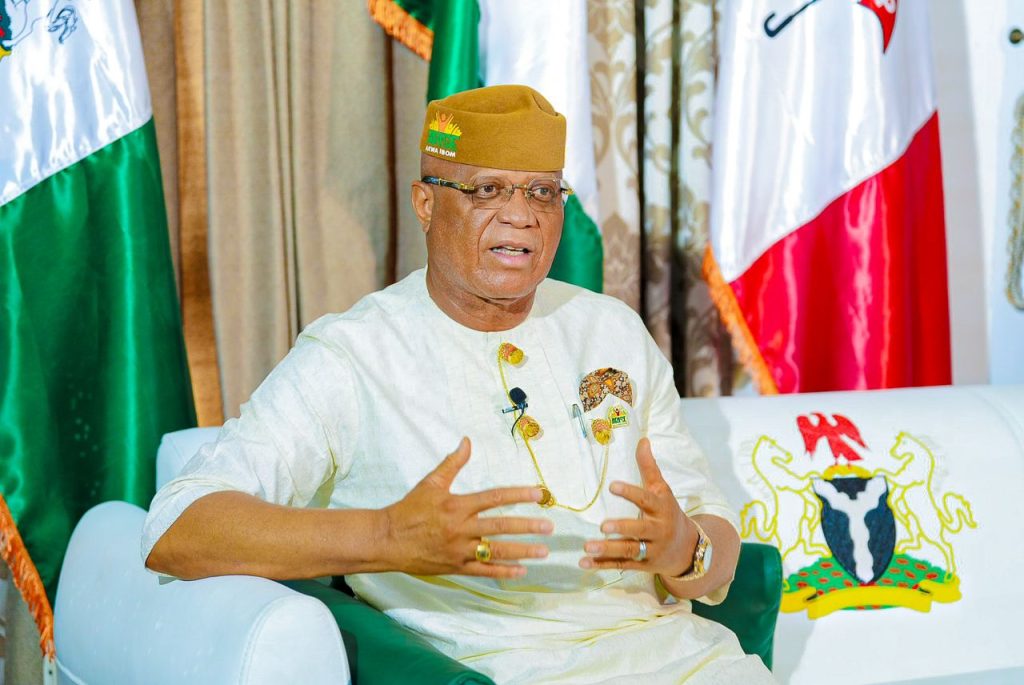
By Lucy Daniel
In a political landscape often divided by party lines and personal interests, one man’s approach to governance in Akwa Ibom State is quietly reshaping Nigeria’s democratic story.
Governor Umo Eno’s leadership, marked by humility, inclusion, and genuine service, is redefining how power should be used in a developing democracy.
Recently, the All Progressives Congress (APC) in Akwa Ibom State publicly commended Governor Eno for what it described as “impactful leadership across all sectors.” The praise came during the party’s State Executive Committee meeting in Uyo, where the APC State Chairman, Obong Stephen Ntukekpo, lauded the Governor for his “people-centered governance and pragmatic leadership.”
In Nigeria’s political culture, where inter-party rivalries often breed animosity, this acknowledgment is nothing short of extraordinary. It signals the rise of a progressive political movement that puts people above politics, a movement anchored on the values of cooperation, shared progress, and responsible leadership.
Governor Umo Eno’s leadership style is anchored on the belief that development must not wear the color of any political party. His open-door policy and non-partisan approach to governance have dismantled old walls of suspicion, replacing them with bridges of understanding.
Under his watch, projects and interventions reach communities based on need, not on political loyalty. Farmers, artisans, entrepreneurs, and civil servants across the state now see a government that listens, engages, and delivers, quietly but steadily.
This sincerity of purpose has earned Governor Eno respect across party lines, even among his fiercest critics. In doing so, he has set a new political tone in Akwa Ibom, one that prioritizes unity, peace, and shared prosperity over partisan conflict.
Beyond Akwa Ibom, the implications of Governor Eno’s leadership are beginning to ripple through the South-South region, and indeed Nigeria. His inclusive and pragmatic style has become a reference point for what is possible when leaders place service above self.
In a region often perceived as politically homogenous and resistant to inter-party collaboration, Governor Eno’s approach offers a new model, one where governance is guided by conscience, not by political calculations. This model could serve as a template for regional stability and national cohesion.
By earning admiration from leaders across political divides, Governor Eno is gradually positioning the South-South as a region capable of transcending politics to pursue a shared vision for growth and equity.
Nigeria stands at a crossroads. The country’s unity has too often been strained by politics that divide rather than develop. Governor Eno’s style reminds us that leadership, at its core, is about humanity, about the welfare of people, not the color of a party flag.
When opposition parties can publicly celebrate the achievements of a sitting governor, it shows a maturing democracy, one that values performance over propaganda. It is a model that Nigeria desperately needs if it must heal old wounds and move forward as one nation.
Governor Eno’s inclusive politics and steady leadership have proven that progress is possible when trust replaces tension, and dialogue replaces division. His example calls on leaders across Nigeria to put people first, foster unity, and make governance a collective effort.
Governor Eno’s progressive movement is more than a local phenomenon, it is a national statement. It represents a shift from confrontation to collaboration, from partisanship to partnership, from politics of power to politics of purpose.
For Akwa Ibom, it means continuity of peace and sustained development.
For the South-South, it means a new image of political tolerance.
And for Nigeria, it rekindles hope, that leadership anchored on sincerity and service can unite rather than divide.
Governor Eno may not seek applause, but his style of leadership is quietly rewriting the rules of engagement in Nigerian politics. He is proving that progress, indeed, begins where unity leads the way.